Hilda Patricia Palencia
Engineering/Leadership/Innovation
LATEST PROJECTS & PROGRAMS

Lunar Atmosphere and Dust Environment Explorer


Lunar Atmosphere and Dust Environment Explorer
01
LADEE
For almost 4 years (2009-2013), I was part of the LADEE team providing Systems Safety and Mission Assurance (SSMA) support for the qualification and flight units of the propulsion structures and other systems integration at Space Systems Loral (SSL) during the fabrication, assembly, and tests such as static, acoustic, pressure, among others. In addition she carried out hundreds of reviews to approve electrical design drawings, test procedures, hazard reports, and other pertinent documentation, which were implemented later for ground and flight operations. I also supported End Item Data Package (EIDP) reviews for several subsystems (structures, electrical, mechanical, etc). Hilda also performed Bent Pin Analysis (BPA) for propulsion electrical connectors and held meetings for Material Review Board (MRB) to evaluate non-conformance events and reports. LADEE launched in September 2013 and completed its full successful mission in April 2014.
In July 2014, I was awarded the Ames Honor Team Award and the NASA Group Achievement Honor Award for LADEE Safety and Mission Assurance Team in August 2014.
02


Electrostatic Discharge Program Manager/ Instructor/Auditor
I obtained an instructor certification from NASA Jet Propulsion Laboratory to teach the ESD control awareness class and to manage and maintain all ESD workstations in the center, as well as support the ESD Association during board meetings for all NASA Centers. The course includes the ESD theory, requirements, control methods and equipment, practices, and role definition for all NASA Ames personnel performing ESD sensitive electrical operations leading to certification to personnel successfully completing the class and test. More than 130 employees obtained certification.
In addition, I assessed and certify more than 50 ESD workstations throughout NASA Ames used for assembly and test sensitive electrical devices and operations for space flight missions. During this certification, I ensured the center's ESD standards and procedures are followed and are within defined limits. This also included carrying out tests and measurements for resistance, resistivity, voltage, and ESD field measurements as well as checking for physical controls, device connectivity, and verification of protective and approved equipment. Some of the electronic test instruments used are surface resistivity & resistance tester, static field meter, humidity/temperature indicator, multimeter, testers, and others. I created and implemented procedures and check lists to test wrist strap monitors to help reduce 100% monitor calibration costs, 18% of total certification costs, and improve process time by 84%.
Additional responsibilities include annual and bi-annual evaluations of these workstations and equipment, maintaining all ESD work instructions, technical procedures, and pertinent documentation as well as attending monthly meetings for the ESD Association committee and to support high-level ESD requirements and documentation.

More than 100 battery packs were fabricated for SPHERES at NASA Ames and sent to the International Space Station


More than 100 battery packs were fabricated for SPHERES at NASA Ames and sent to the International Space Station
03
SPHERES Battery and Smartphone
From year 2011 to 2014, I was the main Systems Safety and Mission Assurance representative, providing technical support and recommendations to this small team for battery component installation, tests such as functional, thermal, bake-out, load, pre-flight, assembly, and for final product verification and certification processes, as well as, ensuring compliance with Ames safety, Johnson Space Center flight, and Material Control Station (MCS) requirements. More than 260 batteries were launched during this time.
The smartphone technology allows SPHERES to become a mobile data collector assistant for the astronauts to independently perform operations such spacecraft positioning, environment analysis, video taking, and data transferring. A total of 6 smart phones have been sent to the International Space Station in 3 different missions.
04

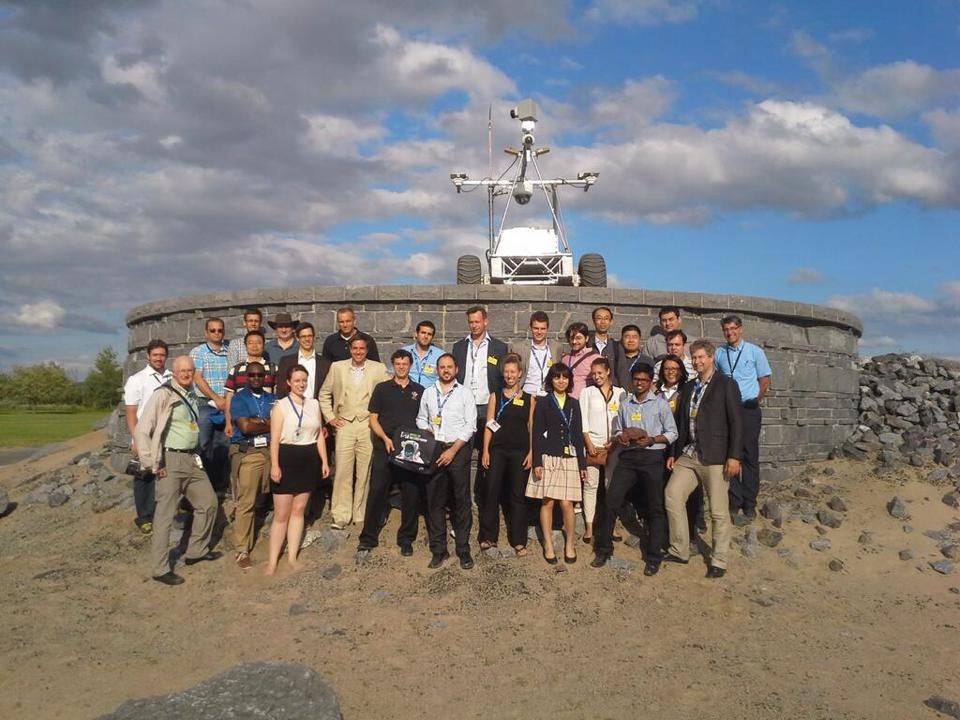
Group Photo after the Simulation with Mars Rover

a photo with Canadian astronaut David Saint-Jacques
Group Photo after the Simulation with Mars Rover
International Space University - Mars Rover and Analog Simulation Science Department SSP 2014
This simulation was carried out at Canadian Space Agency during the Science Department for the Summer Space Program in Montreal, Canada in 2014.
My role was the Rover Navigator Astronaut, monitoring the navigation telemetry (camera views, navigation sensors, etc. ) and provide support to driver operations.
Simulation Description:
This is a team of international interdisciplinary astronauts from the International Space Agency (ISA) on their way to Mars aboard the Alouette spacecraft for an extended exploration mission which will attempt to find signs of past or present life. A fleet of science rovers has been sent to potential landing areas in order to determine the optimal location for human exploration. The remaining distance to travel to the Red Planet is approximately 750,000 km which results in a ~5s round trip delay in communications. With Earth around its closest approach, communications with the Ground Control Center (GCC) will have ~8 minutes two way light time (TWLT) delay. The team will control one of the rovers from interplanetary spacecraft and scout its landing area for relevant science. Team recommendations will serve as the basis to select the human exploration landing site.